
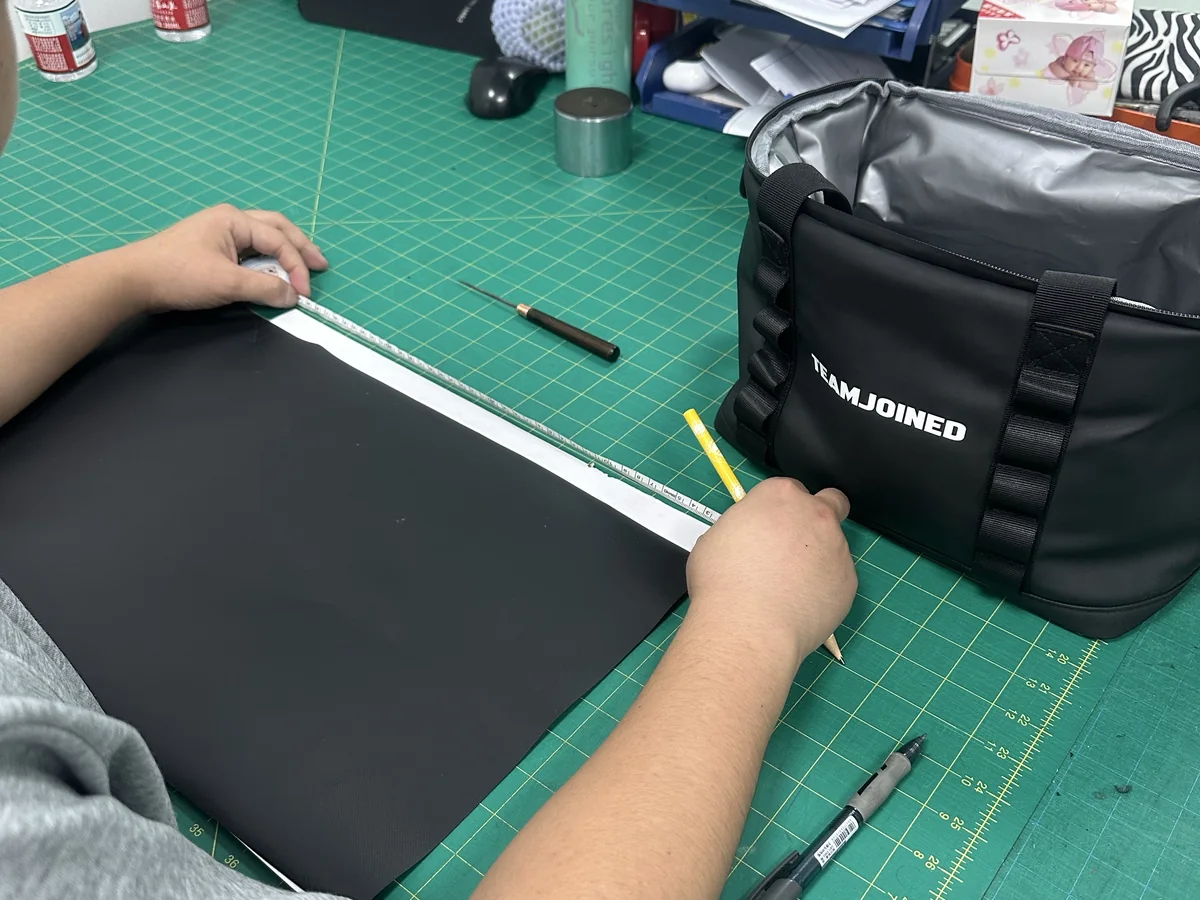

A factory audit and a pre-shipment inspection are not two names for the same quality check. They answer different purchasing questions at different stages of a custom bag order. Some buying organisations use the term supplier audit or supplier quality audit for the first activity, while the second may be described more broadly as a product inspection or product quality inspection.
A factory audit asks whether a supplier has the people, equipment, process controls and records needed to manage the type of project you plan to place. A pre-shipment inspection asks whether a specific production lot appears to match the approved requirements before it is released for shipment. One examines the supplier and its systems. The other examines an order at a defined point in production.
That difference matters for custom outdoor and functional bags. A sewing workshop can look capable during a factory visit while a particular order still contains wrong dimensions, inconsistent stitching, mismatched components or packing errors. The reverse is also possible: a small inspected sample from one lot may look acceptable even though the supplier’s broader controls, traceability or subcontracting arrangements have not been evaluated.
This guide gives brands, importers and private-label buyers a practical way to decide which activity is needed, what evidence to request and how to turn findings into an approval decision. It is a purchasing method, not a claim that every order requires the same audit, sampling plan or acceptance threshold.
The shortest answer: each check protects a different decision
Use a factory audit before you rely on a supplier’s capability claims. Use a pre-shipment inspection before you release a specific finished order. Use both when the supplier relationship or the order risk justifies two separate decision gates.
| Purchasing question | Factory audit | Pre-shipment inspection |
|---|---|---|
| What is being evaluated? | The supplier, site, systems and production capability | A defined production lot for a specific order |
| Typical timing | During supplier qualification or before a new project is committed | When production and packing have reached the agreed inspection stage |
| Main reference | Audit scope, buyer requirements and evidence criteria | Approved sample, specification, artwork, packing requirements and inspection plan |
| Typical evidence | Legal identity, site records, process flow, equipment, staff roles, QC records and corrective-action history | Inspected units, measurements, workmanship observations, functional checks, labels, quantities, packing and photographs |
| What it cannot prove | That a future shipment will be free of order-specific errors | That the factory’s overall systems or long-term capability are adequate |
| Main decision | Approve, conditionally approve, request corrective action or reject the supplier | Release, hold, rework, re-inspect or reject the lot according to agreed rules |
The strongest buying process does not ask which tool is “better.” It asks which decision must be made and which evidence is missing.
Start with the risk, not with the inspection name
Before booking an audit or inspection, define the consequence you are trying to avoid. A buyer developing a technical hiking backpack with a new supplier faces a different risk from a buyer repeating a previously approved tote bag with stable materials and documented production history.
Useful risk questions include:
- Is this a new supplier, a new production site or a previously qualified factory?
- Is the bag construction familiar to the supplier, or does it require new machinery, specialist sewing or unfamiliar materials?
- Are critical components supplied by the factory, nominated by the buyer or subcontracted?
- Is the artwork, colour, fit, pocket layout or packing configuration commercially sensitive?
- Is there an approved physical sample, or are decisions still being made from drawings and digital files?
- Would a delay, rework cycle or rejected delivery create a significant launch or compliance risk?
- Does the buyer need independent evidence for internal approval, retailer onboarding or a regulated market?
The answers determine the scope. A factory audit should not become a sightseeing visit, and a pre-shipment inspection should not become a last-minute attempt to define specifications that were never agreed.
What a custom bag factory audit should examine
A useful factory audit is a structured review of the supplier against a defined scope. It can be performed by the buyer, an authorised representative or an independent inspection organisation. The scope should match the product and the purchasing risk. A generic factory audit checklist that ignores sewn-product processes may miss the controls that matter for bags. The factory audit process should therefore begin with the proposed bag, the buyer’s decision and the evidence needed to support that decision.
1. Supplier identity and production-site control
Confirm which legal entity will contract, invoice and receive payment, and which physical site will make the goods. Record the site address, responsible contacts and the relationship between the contracting entity and the production location.
The buyer should also ask whether cutting, printing, embroidery, lamination, specialised welding, moulding, testing or packing will be performed elsewhere. Subcontracting is not automatically a defect, but undisclosed subcontracting makes responsibility and traceability difficult. The audit should record which processes are internal, which are external and how outsourced work is approved and checked.
For a broader supplier-verification sequence, use the existing guide, How to Verify a China Outdoor Bag Factory Before You Order. The present article focuses on separating that supplier-level decision from an order-level inspection.
2. Capability relevant to the proposed bag
Do not audit only what the factory can display. Audit what the proposed project requires.
For sewn outdoor and functional bags, relevant evidence may include cutting methods, industrial sewing machines, pattern development, sample-making, reinforcement methods, binding, zipper installation, webbing attachment, foam or lining assembly and final packing. The buyer should compare the intended construction with the equipment, operator experience and sample-room capability visible at the site.
The goal is not to count machines for its own sake. It is to identify a credible path from technical file to repeatable production. If a project requires a process not observed during the audit, record how the supplier plans to perform it and what evidence will be available before bulk approval.
3. Material and component control
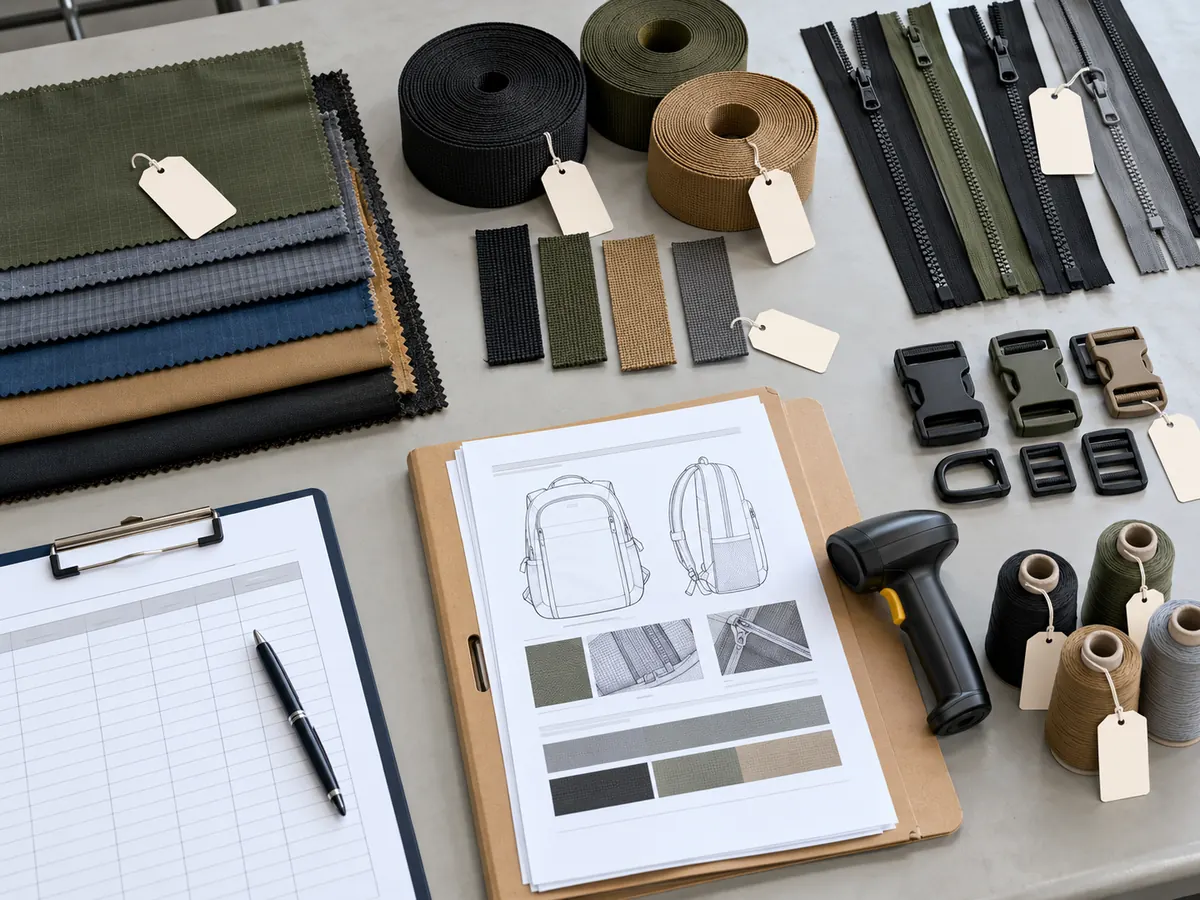
Custom bags combine many inputs: shell fabric, lining, foam, mesh, webbing, zippers, buckles, thread, labels, printing, embroidery and packaging. A factory audit should therefore examine how materials are identified, received, stored, issued to production and protected from mixing.
Ask how the factory links a received material to a purchase order or approved specification. Check whether colour, lot, width, coating, hand feel or other buyer-defined attributes are verified and recorded. For nominated materials, confirm who is responsible for ordering, incoming checks and handling nonconforming deliveries.
This does not replace the buyer’s material specification. The practical material-selection questions are covered separately in the Backpack Fabric Guide: Nylon, Polyester, Oxford and Canvas.
4. Document and sample control
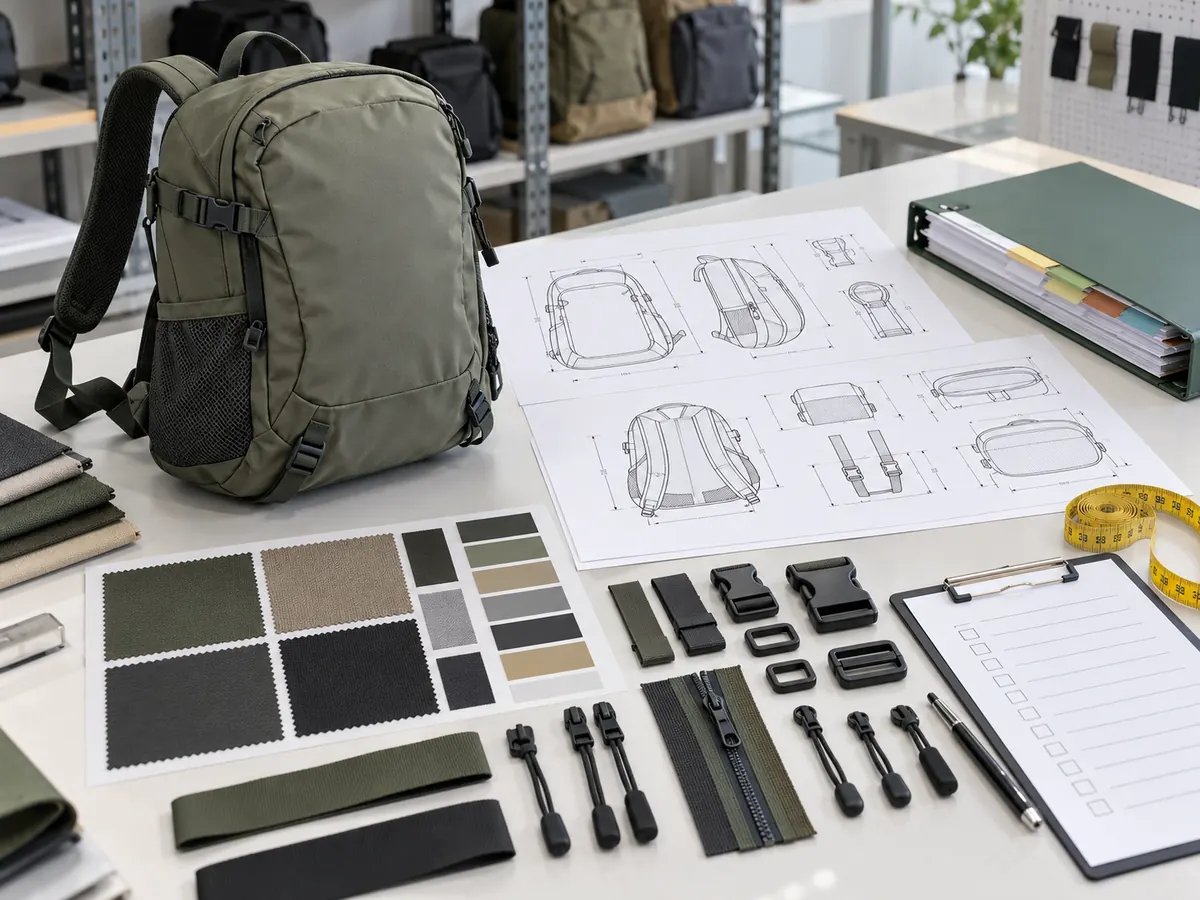
Custom production changes during development. A colour may be adjusted, a pocket moved, a zipper pull replaced or a packing label revised. The audit should examine how the factory prevents an old version from returning to the line.
Look for a controlled reference package: approved drawings, bill of materials or component list, artwork files, colour references, approved samples, revision dates and authorised change records. Ask who can approve a change and how operators and inspectors receive the latest version.
An approved sample is especially important because many bag details are easier to understand physically than in text. However, the sample and written specification should support each other. If they conflict, the buyer and supplier should resolve the conflict before production rather than asking the final inspector to guess.
5. In-process quality controls

The audit should follow the actual production flow. For bags, this may include material inspection, cutting, printing or embroidery, component preparation, sewing, assembly, cleaning, final review and packing.
Ask where defects are most likely to be detected. Check whether in-process records identify the order, operation, date, inspector and disposition. Review how the factory separates defective or questionable work, records rework and confirms that corrected pieces are checked again.
Hongzhao’s existing Outdoor Bag Quality Control page describes checkpoints before, during and after production, with the approved sample and agreed inspection plan used as order references. Buyers should still define the project-specific tolerances, functional checks and records they need.
6. Corrective action and repeat-order learning
An audit is more useful when it examines how problems are closed, not only whether a checklist box is marked. Ask for examples of internal nonconformity records, root-cause analysis, corrective actions and follow-up verification, while respecting confidentiality.
For repeat orders, determine whether earlier issues are transferred into the next production plan. A recurring pocket-position error or weak attachment point should not be rediscovered at each final inspection. It should become a controlled checkpoint with a responsible owner and documented result.
What a factory audit cannot tell you
Even a well-designed audit is a snapshot of a supplier and its systems. It does not approve an order that has not yet been produced.
A factory audit cannot confirm that the final colour matches the latest approval, that all cartons contain the correct quantity, that the finished bag dimensions fall within the agreed tolerances or that the current order uses the approved zipper and label. Those are order-specific questions.
It also cannot guarantee that no defect will occur. The value of the audit is to reduce uncertainty about capability and control. It should produce evidence, findings and actions, not a vague statement that the factory “looks good.”
A pre-shipment inspection checklist for custom bags
A pre-shipment inspection is normally scheduled at an agreed stage when the lot is sufficiently complete for meaningful checks. The buyer should define that stage instead of assuming the term has one universal meaning. If too little is finished, the inspector may not see a representative lot. If the order has already left the factory, the buyer has lost the practical ability to hold, rework or re-inspect it.
The inspection should be built around the order’s controlled reference package. At minimum, provide the current purchase order, approved sample or clearly identified reference sample, specification, artwork, colour references, size table, packing instructions and any agreed inspection plan.
1. Order identity and available quantity
Confirm that the inspected goods belong to the correct order, style, colour and revision. Record the quantity presented, the quantity packed and the stage of completion. If the available quantity does not meet the agreed precondition for inspection, note that limitation before drawing a conclusion.
For multi-style or multi-colour orders, the sample should represent the agreed mix. A favourable result from one easy colourway should not silently stand in for uninspected variants.
2. Appearance, materials and components
Compare the selected units with the approved references. Check the shell, lining, webbing, zippers, buckles, foam, labels and visible trims that the specification identifies.
The inspector should record observations rather than infer technical performance from appearance. A fabric that looks similar is not automatically the approved construction. If fibre content, coating, colourfastness or another property requires laboratory evidence, the buyer should define that requirement separately. A visual pre-shipment inspection is not a substitute for every material test.
3. Dimensions and tolerances
Provide a measurement method, measurement points and tolerances. “Correct size” is not an inspectable instruction.
For bags, relevant dimensions may include finished length, width, depth, strap length, handle drop, pocket opening or panel position. The exact list depends on the design. Measurements should be taken in a consistent condition, such as laid flat or filled according to an agreed method, because soft products can change shape during handling.
Record actual values for the selected units. Do not report only “pass” without the measurements when dimensions are commercially important.
4. Workmanship

Workmanship checks should reflect the construction and intended use. Typical observations can include skipped stitches, broken threads, uneven seam allowance, open seams, raw edges, poor binding, puckering, stains, scratches, loose hardware, distorted panels, misaligned pockets, insecure reinforcement, sharp edges or inconsistent finishing.
The buyer should classify findings according to project risk. A loose decorative thread and a broken load-bearing attachment should not receive the same treatment. The categories and acceptance rules must be agreed before the inspection, not invented after the report arrives.
5. Buyer-defined functional checks
Functional checks should be specific, observable and proportionate. Examples may include operating zippers and buckles, adjusting straps, opening and closing compartments, checking detachable parts, fitting an agreed reference item or following a buyer-provided assembly instruction.
Do not turn a brief manual check into an unsupported performance claim. Opening a zipper several times is not a durability certification. Filling a cooler sample with water is not, by itself, a universal waterproof rating. Carrying one loaded sample for a short period does not establish a safe load for every production unit.
If the buyer requires a performance test, define the method, conditioning, load, duration, equipment, sample count and acceptance criterion. Decide whether it belongs in factory testing, an accredited laboratory or the pre-shipment inspection scope.
6. Branding, labels and packing
Check artwork, logo position, spelling, colour, care labels, hangtags, barcode or retail labels against the approved files. Confirm that protective packing, polybags, inserts, carton marks, assortment and carton quantities follow the order instructions.
Packing errors can make an otherwise acceptable product unusable for a retailer or fulfilment centre. Treat packing as a controlled specification, not an afterthought.
Product inspection vs process control: why one final check is not enough
Product inspection and process control support different parts of the same order. A pre-shipment product inspection evaluates selected finished or packed goods against the agreed references. Process control checks whether materials, cutting, sewing, assembly and corrections are being managed while the order is being made.
The distinction matters because some problems are easier to prevent than to discover at the end. A mixed material lot, obsolete artwork file or incorrectly positioned reinforcement may affect many units before a final inspector arrives. In-process checkpoints can detect the cause earlier, while the final product quality inspection provides evidence about the completed lot presented for release.
Buyers should not choose between them by habit. Define which risks need prevention during production and which require final verification. The approved sample, current specification and issue log should connect both stages so that the final inspection does not start from a different version of the product.
Sampling and AQL: define the plan instead of copying a number
Buyers often associate pre-shipment inspection with AQL. AQL-based sampling can be useful, but a number copied from another project is not an inspection strategy.
ISO 2859-1 describes sampling schemes for inspection by attributes indexed by acceptance quality limit. Applying such a plan requires choices about lot size, inspection level, sample size, defect classification and acceptance or rejection numbers. Those choices should reflect the buyer’s risk and contractual requirements.
Before inspection, document:
- the lot or sub-lot being evaluated;
- how units will be selected;
- the sampling method and sample size, if sampling is used;
- definitions of critical, major and minor findings for the project;
- acceptance and rejection rules;
- which checks apply to every selected unit and which use a smaller subset;
- who can approve a deviation;
- what happens after a failed result.
Some characteristics may require 100 percent confirmation, while others may be sampled. A critical safety, legal or retailer requirement should not be diluted simply because the general visual-inspection sample passed.
Hongzhao does not need to claim one universal AQL for every project. The current quality-control page correctly states that buyer-specific tolerances, sampling plans and AQL requirements should be agreed in advance.
Build an evidence package that another person can review
An inspection report should allow a buyer who was not present to understand what was checked and what was not.
A useful evidence package may include:
- order, style and revision identifiers;
- inspection date, site and production stage;
- available and inspected quantities;
- reference documents and samples used;
- sampling plan and selection method;
- measurement table with actual values;
- defect log with category, quantity and location;
- photographs showing both context and detail;
- functional-check method and observations;
- label, assortment and packing verification;
- unresolved deviations and factory comments;
- the inspector’s result under the agreed criteria;
- buyer disposition and required follow-up.
Photographs should prove a finding, not decorate the report. A close-up of a stitch defect needs enough context to identify where it appears on the bag. A carton photo should show the relevant mark clearly. File names or report references should link the image to the finding.
For a factory audit, the evidence package should similarly identify the scope, people interviewed, areas visited, records sampled, limitations, findings and corrective actions. The factory audit report should distinguish observed evidence from assumptions and should show which corrective actions remain open. ISO 19011 provides general guidance on auditing management systems, including audit principles, programmes and auditor competence. A commercial supplier audit may use a different scope, so the buyer should state exactly what was evaluated.
Turn findings into a controlled decision
The inspection report is evidence. The buyer’s disposition is the business decision.
Possible routes include:
- Release: the lot meets the agreed acceptance rules and no unresolved condition blocks shipment.
- Conditional release: the buyer accepts a clearly documented deviation. The authorised person and reason should be recorded.
- Rework and evidence review: the supplier corrects defined issues and submits records or photographs for review.
- Rework and re-inspection: corrected goods are presented again under an agreed scope.
- Hold: shipment is paused while the buyer assesses an unresolved technical, legal or commercial issue.
- Reject: the lot does not meet the contractual requirements and the buyer follows the agreed remedy process.
Avoid verbal waivers that disappear before the next reorder. If a deviation is accepted for one order, record whether it becomes the new specification or remains a one-time exception. Otherwise, the same dispute may return during the next inspection.
When you need an audit, an inspection or both
Use a factory audit when supplier uncertainty is the main risk
A factory audit is usually the stronger first tool when the buyer is qualifying a new supplier, moving production to a new site, introducing a construction outside the supplier’s demonstrated capability or responding to unexplained changes in quality or delivery performance.
The output should be a qualification decision and a corrective-action plan where needed. It should not be treated as shipment approval.
Use a pre-shipment inspection when the specific order is the main risk
An inspection is usually the stronger tool when the supplier is already qualified but the buyer needs evidence that a particular lot matches the approved sample, specification, artwork and packing plan.
This may be especially relevant for a new style, a significant revision, a high-value launch, complex assortment or an order with past quality issues.
Use both when supplier risk and order risk are independent
A new supplier making a new technical bag may justify an audit before commitment and an inspection before shipment. The audit checks whether the supplier’s system can support the project. The inspection checks what the system produced for this order.
The two reports should connect. Audit findings can become order checkpoints. If the audit identifies weak label control, the inspection plan can require detailed artwork and packing verification. If the audit shows that a process is subcontracted, the order file can require traceability and acceptance evidence for that process.
Do not use either as a substitute for a clear specification
An audit cannot create the buyer’s product requirements. An inspector cannot decide which shade, dimension or construction the buyer intended when references are missing or contradictory.
Before requesting quotations, align the specification so suppliers are pricing the same requirement. The guide How to Compare Custom Outdoor Bag Quotes on the Same Specification explains how to build that controlled comparison.
Common buying mistakes
Mistake 1: treating certificates as complete factory qualification
Certificates can be relevant evidence, but buyers should verify scope, entity, site, issuer and validity. A certificate does not replace product-specific capability review or order inspection. Hongzhao’s publicly presented documents are listed on the Bag Factory Certifications page; buyers should review each document according to their own programme requirements.
Mistake 2: scheduling PSI without an approved reference
If the latest sample, artwork and specification are not controlled, the inspector may compare the goods with an obsolete file or give only general workmanship comments. Freeze the reference package before inspection.
Mistake 3: using vague instructions
Words such as “strong,” “premium,” “waterproof,” “good stitching” or “normal tolerance” do not create consistent acceptance rules. Replace them with defined materials, construction references, measurements, tolerances and test methods where relevant.
Mistake 4: waiting until inspection to discuss defects
Define critical, major and minor findings before the order reaches inspection. State which issues require a hold and who may approve deviations. Negotiating every definition after a failure wastes time and weakens consistency.
Mistake 5: confusing inspected samples with the entire lot
A sample-based result describes the lot under the selected plan and observed evidence. It is not a promise that every unit is identical. Buyers should combine supplier qualification, process control, agreed sampling and appropriate testing rather than expecting one final check to carry the whole quality system.
Mistake 6: failing to close corrective actions
A report without owners, deadlines and verification leaves the risk open. Track each finding to evidence of correction, buyer disposition or an explicit decision not to proceed.
Information to prepare before contacting a custom bag supplier
You do not need a finished inspection manual before the first conversation, but a useful project brief should contain enough information to identify the risk and plan the controls.
Prepare:
- bag type and intended use;
- target market and any retailer or programme requirements;
- drawings, dimensions and reference samples, if available;
- material and component directions;
- logo, label and packing requirements;
- planned order quantity and style or colour breakdown;
- target timing;
- functions that require specific confirmation or testing;
- known failure risks from earlier versions or suppliers;
- whether the supplier or site is new to your organisation;
- audit, inspection, laboratory or documentation requirements;
- the person authorised to approve samples and deviations.
For the wider development sequence, review OEM Outdoor Bag Manufacturing Services and the Custom Outdoor Bag MOQ, Sampling and Lead Time Guide. Specific minimum-order requirements depend on the style and customisation and should be confirmed for the project rather than inferred from this inspection guide.
A practical handoff from qualification to shipment approval
The best result is not two isolated checklists. It is one evidence trail across the project.
- Define the product and supplier risks.
- Audit the supplier where qualification evidence is needed.
- Convert audit findings into corrective actions and order-specific checkpoints.
- Approve the sample and controlled specification.
- Confirm materials, artwork and revisions before bulk production.
- Monitor the agreed production checkpoints.
- Perform the pre-shipment inspection at the defined completion stage.
- Record the buyer’s disposition and any required rework or re-inspection.
- Transfer lessons into the next order’s specification and control plan.
This sequence gives the factory, inspector and buyer the same reference. It also makes future orders easier to review because decisions are recorded instead of reconstructed from email threads.
Discuss the right quality gate for your bag project
If you are preparing a custom outdoor or functional bag order, send Hongzhao the product type, drawings or reference sample, materials, branding, quantity, target timing and the checks your organisation requires. The team can review which project details must be fixed before sampling and which records can support production and final approval.
Submit your project requirements to start a project-specific review. A factory audit or inspection scope should be agreed for the order; this guide does not create a universal acceptance standard or replace the buyer’s contractual requirements.
Frequently asked questions
Is a factory audit the same as a product inspection?
No. A factory audit evaluates the supplier, production site and relevant systems against an agreed scope. A product inspection evaluates selected goods from a specific order against approved references and inspection criteria.
Can a passed factory audit replace pre-shipment inspection?
Not automatically. An audit may support supplier approval, but it does not confirm that a later order uses the correct materials, dimensions, artwork, quantities or packing. The buyer should decide whether the order risk justifies inspection.
Can a passed pre-shipment inspection prove the factory is reliable?
It provides evidence about the inspected lot under the stated scope and sampling method. It does not by itself prove the factory’s legal identity, capacity, subcontracting controls, management systems or long-term performance.
Does every custom bag order need the same AQL?
No. Sampling plans, inspection levels, defect classes and acceptance rules should be agreed according to the product, market, contract and buyer risk. Hongzhao does not assume one fixed AQL for every project.
When should a pre-shipment inspection be booked?
Book it for the completion stage agreed with the supplier and inspector, early enough that the goods can still be held, corrected and re-inspected if necessary. Confirm the available quantity and packing status before the visit.
What should buyers send to the inspector?
Send the current purchase order, approved sample or identified reference sample, specification, measurements and tolerances, artwork, colour references, packing instructions, inspection plan, defect definitions and decision rules. Resolve contradictions before inspection.
Who decides whether a failed lot can ship?
The authorised buyer decides according to the contract and agreed disposition process. The inspector reports evidence and the result under the inspection criteria; the supplier should not unilaterally waive a buyer requirement.
Should buyers audit Hongzhao or use an independent inspector?
Buyers should follow their own supplier-qualification and order-control requirements. They may conduct reviews themselves, appoint a representative or use an independent organisation. The scope, access, confidentiality and records should be agreed before the activity.
Further Reading
Related Products