
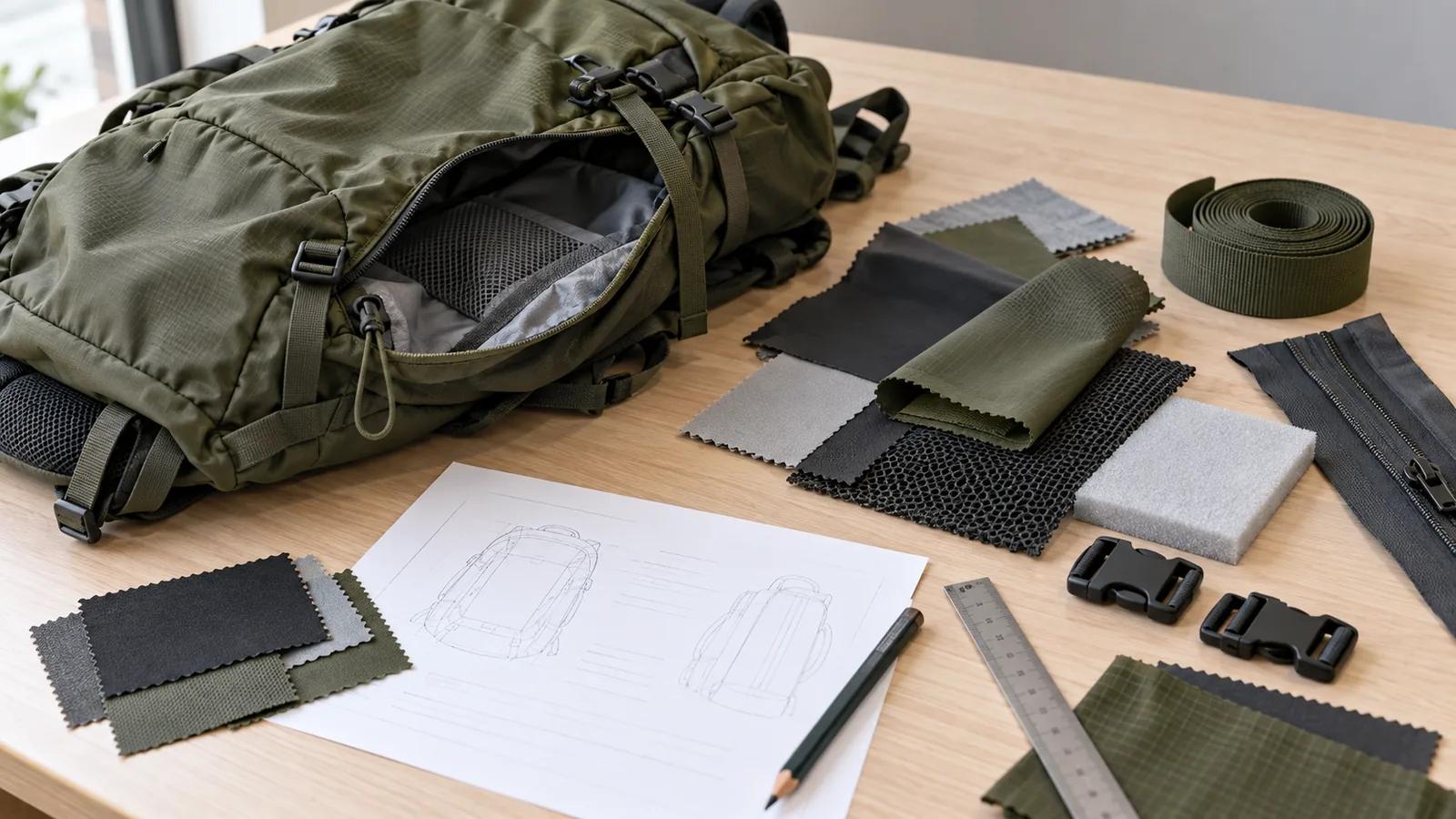

A backpack material specification should do more than name a fabric. It should tell a manufacturer what the bag is expected to do, which material system supports that use, which details are fixed, which details remain open for review, and what evidence will be used to approve the sample.
That distinction matters in OEM purchasing. A request such as "600D polyester backpack with good zippers" may be enough to start a conversation, but it is not a controlled basis for comparing quotations or approving a sample. Two factories can interpret the same sentence differently. They may quote different fabric weights, coatings, lining qualities, foam densities, zipper constructions, webbing grades, reinforcement methods and testing scopes. The totals may look comparable while the products are not.
This guide gives outdoor brands, importers and private-label buyers a practical way to prepare a backpack material specification before OEM sampling. It focuses on the decisions that reduce ambiguity during quotation, material review and sample approval. It does not replace a buyer's own technical requirements, applicable regulations or product-specific testing plan.
The short answer: what should a backpack material specification contain?
A useful specification identifies the product use, target market, size and expected load direction, then separates the backpack into material and component groups. At minimum, it should cover:
- outer shell fabric and any secondary shell panels;
- coating, backing or lamination;
- lining and internal pocket materials;
- foam, board, spacer mesh and other structural layers;
- webbing, binding tape and elastic;
- zippers, sliders, pullers, buckles, hooks and adjusters;
- thread, seam construction and reinforcement points;
- logo, labels, color references and packaging;
- dimensions, tolerances and sample approval evidence;
- any product-specific performance or compliance requirements.
The objective is not to fill every field with a confident guess. A buyer may leave a field open for factory recommendation, but the field should be visibly open and connected to the intended use, cost target and approval process. "Factory to propose two available options" is clearer than leaving the material unnamed and discovering the difference after the sample arrives.
Why a fabric name alone is not enough for an OEM quotation
"Nylon," "polyester" and "Oxford" are useful starting terms, not complete purchasing specifications. Fiber, yarn size, weave, fabric weight, backing, coating, finish, color and supplier can all change the handfeel, appearance, sewing behavior, cost and availability of a fabric.
Denier also does not describe the complete finished material. It refers to yarn linear density. It does not by itself confirm fabric weight, weave density, abrasion performance, tear strength, water resistance or the quality of a coating. A higher denier number is not an automatic guarantee that the finished backpack will be more suitable for the buyer's use.
The same problem appears with components. "YKK zipper or equivalent," "strong buckle" and "thick foam" can produce very different interpretations unless the buyer defines the functional requirement, acceptable alternatives and approval reference. Even a good component can be unsuitable if its size, installation or surrounding construction does not match the bag.
For a basic comparison of common backpack fabrics, use Hongzhao's backpack fabric guide covering nylon, polyester, Oxford and canvas. The present guide serves a different purpose: it shows how to turn material choices into a controlled OEM specification.
Start with the use case, not a material catalogue
Before choosing a backpack material, define what the bag is expected to carry and where it will be used. A factory cannot responsibly select a complete material system from the words "outdoor backpack" alone. That category may include a lightweight daypack, a structured travel pack, a hiking-inspired promotional bag or a multi-compartment pack carrying electronics.
Give the supplier a concise use-case brief:
- Target user and use: Who carries the bag, what goes inside and how often is it used?
- Target market: Where will it be sold or distributed, and which buyer standards apply?
- Size and capacity direction: Provide dimensions, required compartments and a capacity target if it has been calculated.
- Expected load direction: State the intended contents or target working load for design review. Do not turn an untested estimate into a guaranteed load claim.
- Environment: Describe expected exposure to rain, abrasion, dirt, heat, cold or frequent cleaning.
- Appearance: Define the desired handfeel, structure, surface, color and brand position.
- Commercial limits: Give the estimated quantity, target cost direction and launch timing.
These inputs help the factory explain tradeoffs. For example, a lighter shell can reduce weight but may need reinforcement at attachment points. A rigid foam can hold a silhouette but make sewing and packing more difficult. A custom-dyed fabric may create a different material MOQ from an available stock color.
Build the specification as a material system
A backpack is not made from one fabric. It is an assembly of layers, trims and load paths. Treating it as a system makes it easier to see where a quotation changes and where a sample needs approval.
| Specification group | Buyer should define | Factory should confirm | Approval evidence |
|---|---|---|---|
| Outer shell | Intended fiber, look, color and use | Available construction, weight, backing and MOQ | Swatch plus sample |
| Lining | Color, visibility, cleaning and pocket needs | Fiber, weight and availability | Swatch plus finished interior |
| Structural layers | Target firmness, comfort and panel use | Foam, board, mesh and thickness options | Section review plus sample |
| Webbing and binding | Width, color, handfeel and load path | Material, thickness and available colors | Component card plus sample |
| Zippers and hardware | Opening type, size, color and function | Series, slider, buckle and adjuster options | Approved component list |
| Reinforcement | Critical attachment points | Patch, bartack or construction proposal | Drawing plus sample review |
| Branding | Logo method, size, color and location | Process compatibility and setup needs | Artwork proof plus sample |
| Packing | Unit protection and carton requirements | Material, count and carton feasibility | Packing approval record |
This table is a control framework, not a universal bill of materials. The final list must be matched to the actual backpack design.
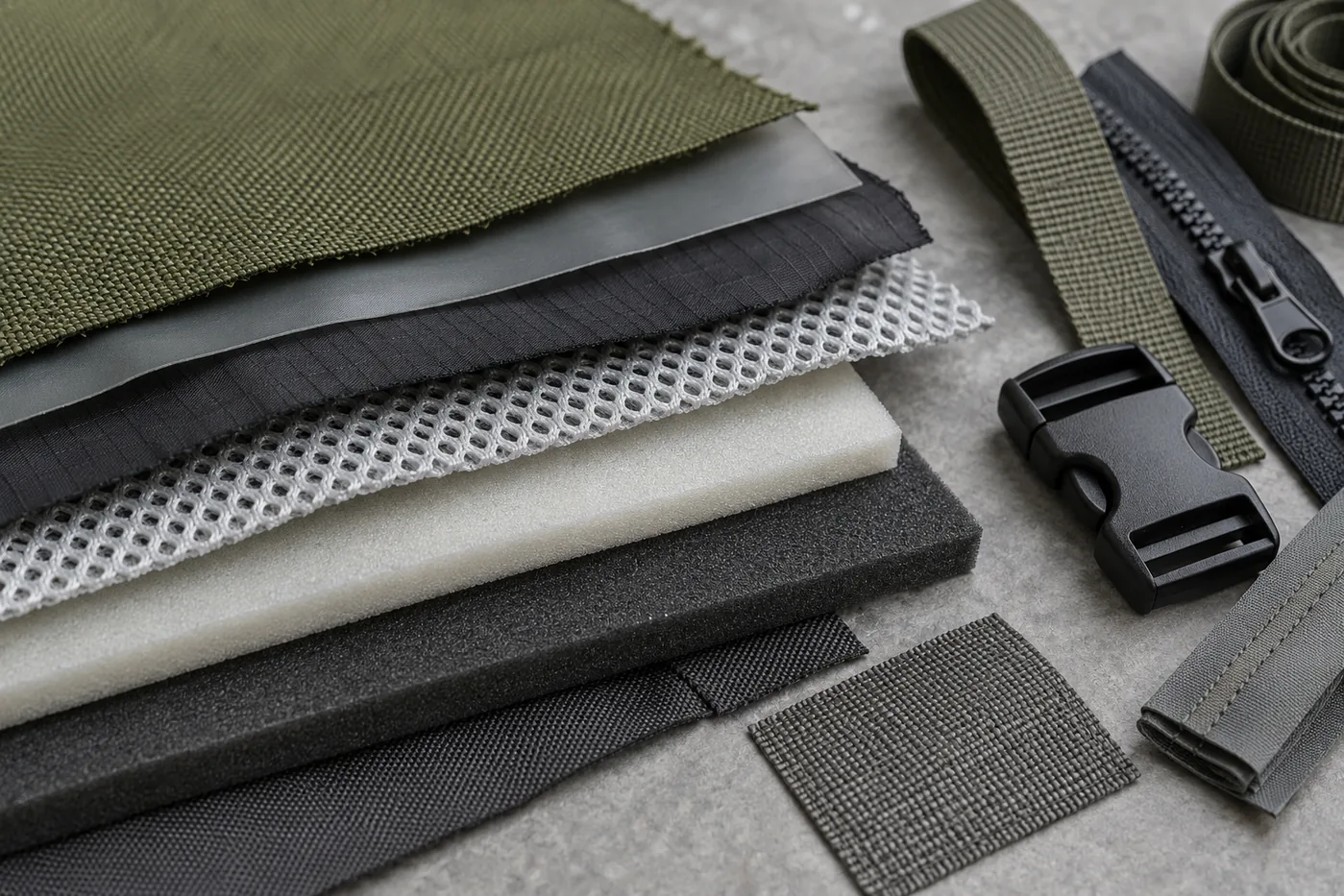
1. Specify the outer shell beyond fiber and denier
The outer shell is often the first line on a material list, but it should contain more than "polyester" or "nylon." Ask the supplier to record the following fields:
- fiber and fabric construction;
- nominal denier or other yarn specification where relevant;
- finished fabric weight or an agreed reference sample;
- usable width if it affects consumption or cutting;
- weave or surface character;
- coating, backing or lamination type;
- finish, sheen and handfeel;
- color reference and color-approval method;
- any required test method and acceptance criterion;
- supplier, mill or article reference when continuity is important.
Not every program needs laboratory values for every field. The point is to connect important claims to evidence. If water resistance matters, define the intended test method and acceptance requirement rather than using the word "waterproof" as a general adjective. A coated fabric does not automatically make the complete sewn bag waterproof. Needle holes, zipper construction, seam design and openings also affect the finished result.
Color needs similar control. A screen color, Pantone reference, fabric swatch and bulk fabric can appear different under different lighting and on different fibers. State whether approval will be based on a physical swatch, lab dip, production lot sample or another agreed reference. Also define which components are expected to match exactly and which may use the nearest available standard color.
2. Separate the lining from the shell specification
The lining affects interior appearance, cleaning, pocket construction and sewing. It should not be left as "standard lining" unless the buyer accepts the factory's documented standard and approves it in the sample.
Useful lining fields include:
- fiber and construction;
- color and opacity;
- approximate weight or approved reference;
- coating or backing, if any;
- handfeel and noise expectations;
- use in the main compartment, pockets or sleeves;
- cleaning or stain concerns;
- printing or branding requirements.
A light-colored lining can improve visibility inside a dark pack, while a darker lining may better conceal marks. A thin lining can reduce cost and weight but may require a different pocket or seam treatment. The right choice depends on the product brief, not a universal ranking.
3. Define foam, board, mesh and structural layers by function
"Use thick foam" is difficult to quote consistently. Thickness is only one variable. Foam type, density, compression behavior, recovery, lamination and placement all change the result. A shoulder strap needs a different discussion from a laptop sleeve or a padded back panel.
For each padded or structured area, identify:
- component location;
- intended function, such as cushioning, shape retention or comfort;
- material type or options to be reviewed;
- thickness range;
- firmness or density direction;
- number of layers;
- cover material, mesh or lining;
- edge treatment and attachment method;
- sample review point.
For spacer mesh, specify the location, color, thickness direction and expected handfeel. Do not assume that a thicker-looking mesh automatically provides better comfort. The panel shape, foam beneath it, seam placement and carrying system must be reviewed together.
4. Treat webbing as part of the load path
Webbing is used for shoulder straps, compression straps, carrying handles, adjustment points and attachment loops. Its specification should match the component's role.
Record the webbing width, fiber, thickness or handfeel, weave, color, surface appearance and expected hardware compatibility. Confirm whether the color must match the shell, match another trim or use an available standard shade. If the webbing passes through an adjuster, the pair should be evaluated together because webbing thickness and surface can affect adjustment and slippage.
The sewing detail is equally important. State which attachment points are critical, then agree how they will be reinforced and inspected. A material name alone cannot establish the strength of a handle or shoulder strap. The webbing, seam allowance, reinforcement patch, stitch pattern, thread, panel construction and test method all contribute.
5. Control zippers, sliders, pullers and opening construction
Zippers are often described only by brand or size. A better specification also identifies:
- zipper type and nominal size;
- chain and tape color;
- coil, molded tooth or other construction;
- slider type and number of sliders;
- locking or non-locking direction where relevant;
- puller design and logo treatment;
- end stops and garage details;
- opening length and orientation;
- water-resistant or covered construction if required;
- approval reference and functional checks.
If a buyer permits an alternative, define what "equivalent" means for the project. It may refer to dimensions, operating feel, color, availability, performance evidence or brand requirement. A substitution should be visible in the revision record rather than silently introduced during sampling or production.
6. Match buckles and adjusters to webbing and use
For buckles, hooks, D-rings, ladder locks and cord hardware, record the component type, size, material, color, mating parts and intended use. Confirm that the slot width matches the selected webbing and that the component fits the panel geometry.
Hardware selection can also affect tooling, MOQ, lead time and branding. A standard available buckle may support a faster development path. A custom molded or branded component can require separate setup, tooling and minimum quantities. The quotation should separate these commercial effects instead of hiding them inside a single bag price.
7. Specify thread, binding and reinforcement before sample approval
Thread and binding may seem minor in an early concept, but they influence appearance and workmanship consistency. Define thread color, visible contrast or matching direction, binding width and color, and any critical seam or edge treatment.
Mark reinforcement points on a drawing or annotated sample. Typical review locations may include shoulder-strap roots, carrying handles, compression-strap anchors, hip-belt connections and other buyer-defined load points. The appropriate construction must be reviewed for the particular backpack. Do not convert one sample observation into a general strength guarantee.
Hongzhao's hiking backpack drawing review explains why dimensions, webbing, hardware and carrying structure need clarification before sampling. Use that workflow to identify open design decisions, then use the material specification to record the approved direction.
8. Connect logo methods to the selected material
A logo process cannot be approved in isolation from the material and panel construction. Embroidery, screen printing, heat transfer, woven labels, rubber patches and other methods behave differently on coated fabrics, mesh, curved panels and padded assemblies.
The specification should include:
- artwork version;
- method;
- dimensions;
- color reference;
- location and orientation;
- distance from seams or edges;
- backing or reinforcement requirement;
- appearance standard;
- approval method.
Approve the logo on the intended substrate where possible. A proof on paper or a different fabric may not show the final texture, color or edge quality.
9. Define performance requirements as methods and criteria
Words such as durable, waterproof, heavy duty and premium are not measurable specifications. Replace them with the requirement that matters and the evidence needed to evaluate it.
A buyer may need to define, depending on product and market:
- fabric abrasion or tear requirement;
- colorfastness requirement;
- coating adhesion or hydrostatic resistance requirement;
- seam, handle or strap test;
- zipper or buckle cycling requirement;
- dimensional tolerance;
- restricted-substance or market compliance requirement;
- inspection sampling plan and acceptance criteria.
The exact standards and limits must come from the buyer's product, destination market and risk assessment. Hongzhao should not invent a universal number. When the buyer has no test plan yet, the open point should be recorded and reviewed before a claim appears in product copy, packaging or a purchase order.
The Hongzhao quality-control page shows where material, in-process and final checks fit into production. The approved material specification and sample are the references that make those checks meaningful.
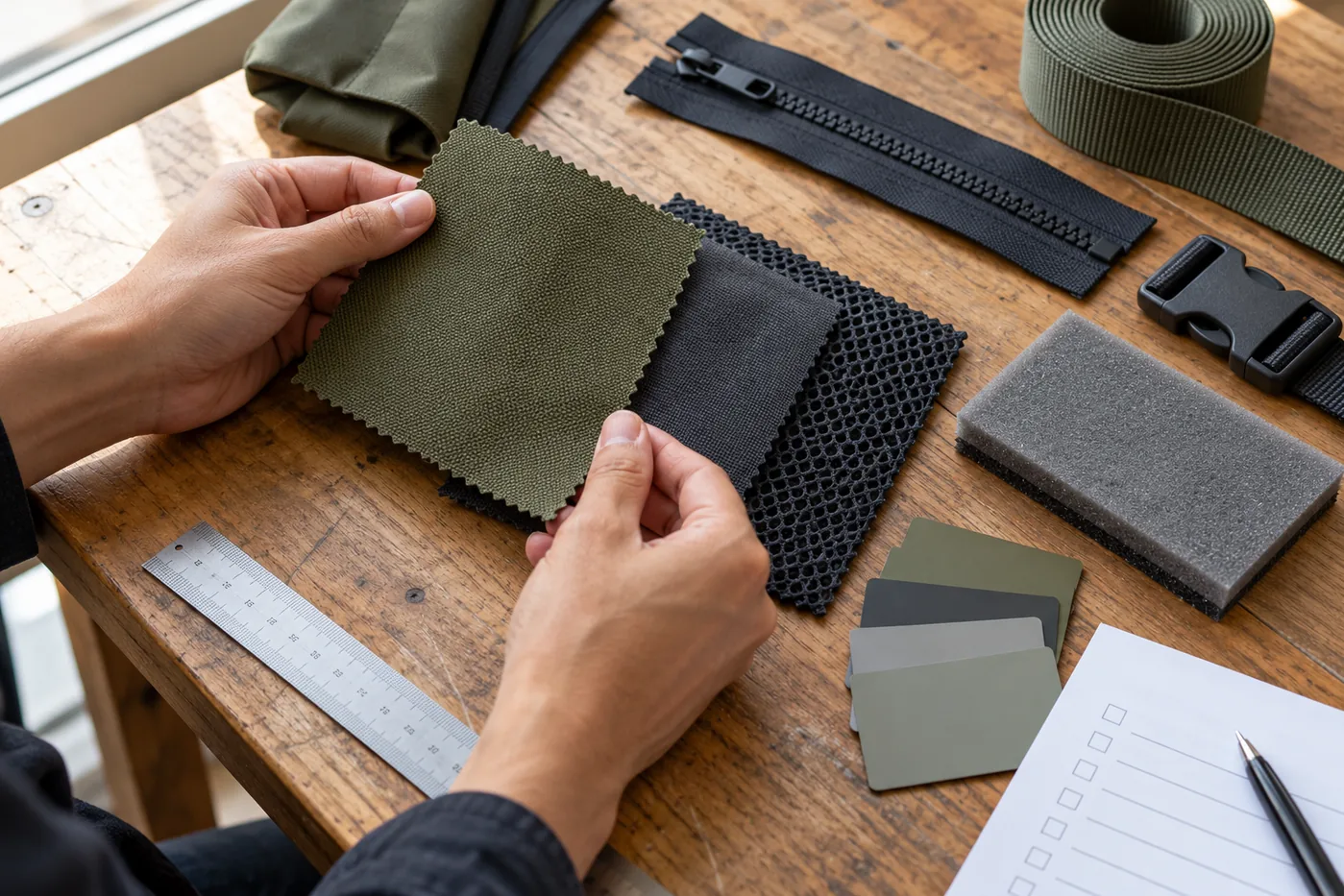
10. Create a controlled component approval set
A long spreadsheet is not enough if the physical materials are ambiguous. Build a controlled approval set that links documents to actual samples.
The set can include:
- dated material and component list;
- numbered swatches or a material card;
- color references;
- component photographs with scale;
- approved artwork files;
- current drawing or tech-pack revision;
- sample issue list;
- approved sample or sealed reference sample;
- approved packaging example;
- record of permitted alternatives.
Use stable item codes. "Black buckle" is easy to misunderstand when a project uses several black components. "Buckle B03, 25 mm, matte black, side-release" is easier to track through quotation, sampling and inspection.
11. Prepare an RFQ that produces comparable quotations
To compare factories or quotation revisions, send the same controlled input to each party. At minimum, include the current drawing or reference, product dimensions, estimated quantity, destination market, required materials, branding, packaging and testing scope.
Ask suppliers to show assumptions and exceptions. A useful quotation response identifies:
- materials included in the price;
- stock versus custom color assumptions;
- included logo process;
- packaging basis;
- estimated material or order MOQ;
- sample cost and setup charges;
- excluded tests or third-party costs;
- proposed alternatives;
- validity period and lead-time assumptions.
Do not compare only the final unit price. Check whether each price is based on the same material system and approval scope. A lower number may reflect a lighter lining, different coating, generic hardware, omitted testing or a stock color instead of the requested custom color.
For the commercial comparison method, read how to compare custom bag manufacturer quotes on the same specification.
12. Use revision control before and after sampling
Material decisions change during development. The problem is not change itself; it is unrecorded change.
Give the specification a revision number and date. When a material, component, dimension or process changes, record:
- what changed;
- why it changed;
- who requested or approved it;
- effect on cost, MOQ, sample timing or performance;
- which drawings, lists and samples are superseded;
- the next approval step.
Keep one current source of truth. Do not rely on a mixture of chat screenshots, old spreadsheets, marked samples and memory. A small revision table can prevent the factory, buyer and inspection team from using different versions.
13. Review the sample against the specification, not against expectation
The first backpack sample is a decision tool. It allows the buyer and factory to evaluate the combined effect of materials, dimensions, structure, workmanship and branding.
Review the sample systematically:
- Confirm the sample revision and material-card revision.
- Check dimensions and compartment layout.
- Compare shell, lining, mesh, foam, webbing and components with the approved references.
- Operate all zippers, buckles, adjusters and closures.
- Review the carrying structure and intended contents.
- Check logo method, location and color.
- Record deviations with photographs and measurements.
- Separate required corrections from optional preferences.
- Update the drawing, specification and issue list together.
- Confirm whether a revised sample or limited component approval is required.
Sample approval does not prove every bulk unit or every performance claim. It establishes an agreed construction reference. Bulk controls, inspection criteria and any required testing still need to be defined.
A practical pre-sampling checklist for buyers
Use this list before requesting an OEM backpack sample:
Product brief
- Intended user and use are stated.
- Target market and relevant requirements are identified.
- Main dimensions, compartments and capacity direction are recorded.
- Intended contents or load direction are described.
- Estimated quantity and target timeline are included.
Materials
- Shell and secondary fabrics are separately listed.
- Coating, backing, finish and color approval are defined.
- Lining and pocket materials are identified.
- Foam, mesh and structural layers are listed by location and function.
- Webbing, binding, elastic and reinforcement materials are specified.
Components
- Zipper construction, size, color, slider and puller are defined.
- Buckles, adjusters, hooks and rings have item references.
- Thread and visible stitching direction are confirmed.
- Logo and label methods are matched to the substrate.
Approval and commercial controls
- Current drawing or tech pack has a revision date.
- Physical swatches or component references are numbered.
- Open decisions and permitted alternatives are visible.
- Testing and compliance responsibilities are assigned.
- Sample cost, setup cost, MOQ and quotation assumptions are separated.
- Sample-review method and approver are identified.
- Packaging and carton-mark requirements are included.
Common specification mistakes that delay OEM sampling
Copying a retail product description
Retail copy explains benefits to consumers. It rarely contains enough construction detail for a factory. Use the retail reference to explain design intent, then create a separate manufacturing specification.
Selecting material only by denier
Denier does not define the complete fabric. Add construction, weight or approved reference, coating, finish, color and required evidence.
Treating "waterproof" as a fabric synonym
A water-resistant fabric and a waterproof finished bag are different claims. Define the required product construction and test method before making either claim.
Ignoring lining, foam and trims until after quotation
These inputs affect cost, MOQ, sample appearance and function. Leaving them open can make early quotations incomparable.
Asking the factory to choose everything without a use case
Factory input is valuable, but it needs a boundary. State the user, environment, price direction and approval priority, then ask for documented options.
Approving changes only in chat
Move approved decisions into the current drawing, material list and issue record. Chat should support the record, not replace it.
Using the sample as the only specification
A physical sample is useful, but hidden layers, exact components, tolerances and permitted alternatives still need written control.
Illustrative example: turning a vague request into a reviewable brief
The following is a generic example, not a claim about a completed customer order.
Vague request: "We need a durable 30 L waterproof hiking backpack in 600D with strong buckles."
Reviewable development brief: "Develop a hiking-oriented backpack around the attached dimensions and compartment drawing. Target nominal capacity is subject to pattern calculation and sample confirmation. The bag will carry clothing, food, a water bottle and small outdoor equipment. Propose two olive shell options with different weight and cost directions, and state fiber, construction, backing, available width, color basis and material MOQ. Provide a separate charcoal lining option, shoulder-strap and back-panel foam proposals, spacer-mesh options, 25 mm and 38 mm webbing references, zipper and buckle item codes, and reinforcement proposals for the handle and shoulder-strap roots. Water resistance is a development objective, not an approved finished-product claim; identify the fabric and construction options plus the test information needed. Quote stock-color and custom-color routes separately. Sampling may start only after the buyer approves the material card and open-point list."
The second version does not pretend that all engineering decisions are complete. It gives the factory enough context to propose controlled options and gives the buyer a basis for comparing them.
What to send Hongzhao for a material specification review
For a custom outdoor backpack project, send the information you already have:
- reference sample, drawing, tech pack or clear product images;
- intended use and target market;
- size and compartment requirements;
- preferred material direction or examples;
- logo artwork and branding method;
- estimated quantity;
- packaging needs;
- target schedule;
- known test, compliance or inspection requirements;
- questions that remain open.
Hongzhao can review the information, identify missing decisions and discuss feasible material directions before sampling. The broader capability and project inputs are listed on the custom outdoor backpack manufacturer page. Buyers who have an idea or reference but no complete tech pack can also review the ODM outdoor bag development process.
Frequently asked questions
Is 600D polyester enough information for a backpack quotation?
No. It is a starting material description. A comparable quotation should also identify or control fabric construction, finished weight or approved reference, coating or backing, color, lining, foam, webbing, zippers, hardware, branding, packaging and testing assumptions.
Should a buyer specify every material or ask the factory to recommend options?
Either route can work. A mature buyer may nominate exact materials and suppliers. A buyer without a full tech pack can state the use case, cost direction and approval criteria, then ask the factory to propose documented options. Open fields should be explicit rather than hidden.
Does a coated backpack fabric make the finished bag waterproof?
Not by itself. The finished result also depends on seams, needle holes, zippers, openings and construction. Define the required claim, test method and acceptance criterion for the complete product.
When should physical swatches be approved?
Approve key shell, lining and visible trim references before sampling when they materially affect appearance, cost or construction. Record swatch codes and revisions so the sample and later production can be checked against the same references.
Can the material specification change after the first sample?
Yes. Sampling often reveals needed changes. Record each approved change, its effect and the new revision. Update the specification, drawing and issue list together.
What is the difference between a material specification and a bill of materials?
A material specification defines required characteristics, options, evidence and acceptance criteria. A bill of materials lists the items and quantities used in the product. In practice they should be linked, but they serve different control purposes.
Does this checklist guarantee backpack performance?
No. It improves clarity before quotation and sampling. Product performance depends on the complete design, selected materials, construction, workmanship, testing and order-specific quality controls.
Next step: turn your material questions into a controlled sample brief
A useful backpack material specification is not the longest document. It is the document that makes the important decisions visible, connects each requirement to evidence and keeps quotation, sampling and approval on the same revision.
Send Hongzhao your current drawing, reference, intended use, estimated quantity and unresolved material questions. The team can review which fields are ready, which need buyer confirmation and which can be developed as factory proposals before the first OEM sample.