
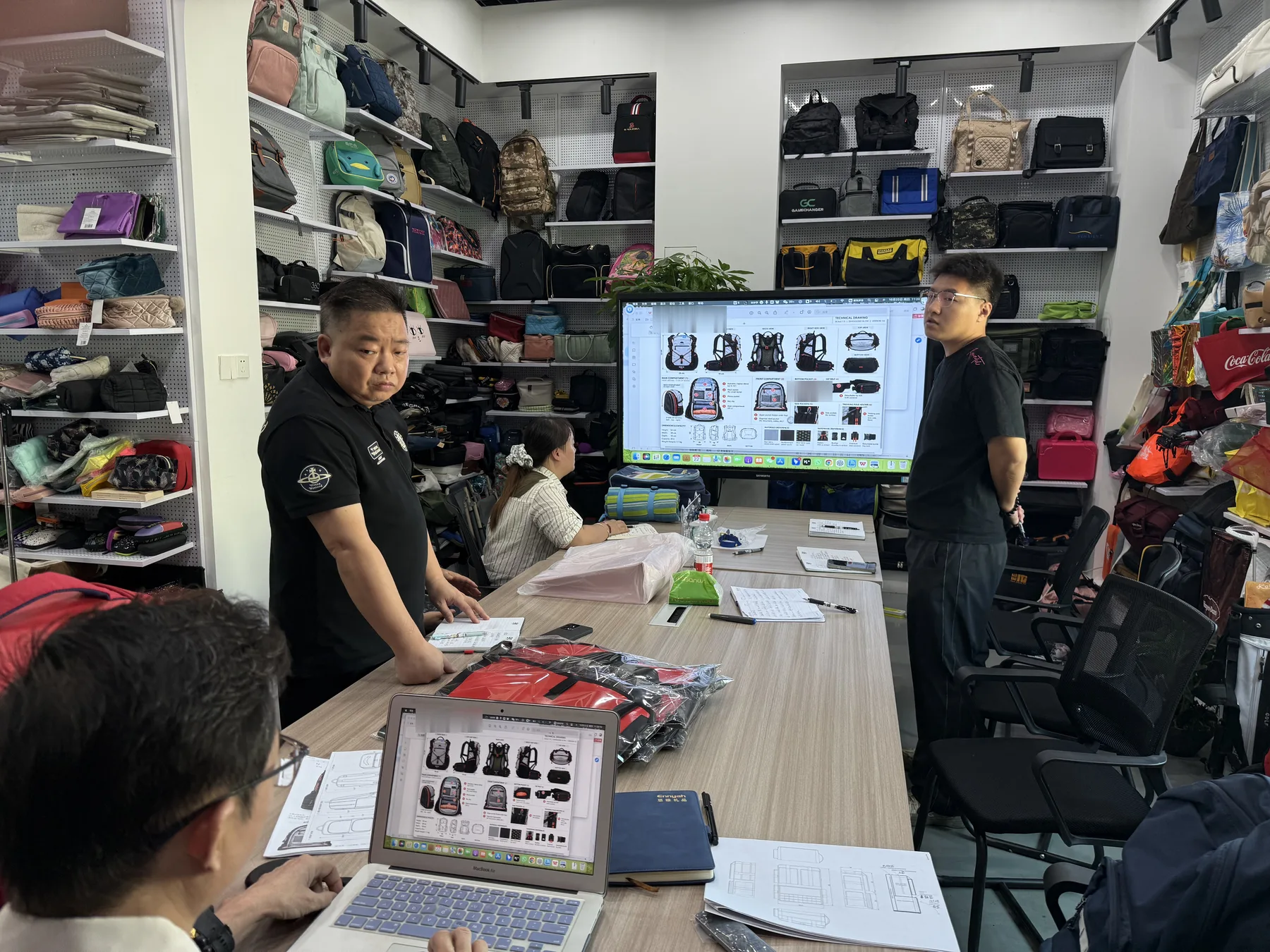

A brand can know the backpack it wants to develop without having every production detail settled. A drawing may show the overall shape, pockets and carrying system, yet leave important questions about dimensions, capacity, webbing, buckles and attachment points. If a factory treats those gaps as final instructions, the first sample may answer the wrong questions.
In a recent hiking backpack discussion, a buyer shared a preliminary design drawing with Hongzhao. Our team gathered around the drawing to examine how the proposed parts would relate to one another and which details needed the buyer’s confirmation. The photographs from that discussion document a real design review. They do not show an approved specification, a finished sample or a tested product.
This article explains the review method illustrated by that meeting. It is intended for outdoor brands, importers and sourcing teams preparing an OEM or ODM backpack project, especially when their first design is a concept rather than a complete technical pack.
The first task is to separate what the drawing shows from what it does not
A multi-view illustration is useful. It helps a team locate a proposed compartment, inspect the relationship between the pack body and shoulder straps, and notice where a fastening or attachment appears. But an illustration does not automatically define a manufacturing instruction.
For example, a pocket shown from the front may not reveal its usable opening, the object it must fit, the method used to construct it or its relationship to the packed main compartment. A strap drawn in place may not define its width, adjustment travel, attachment construction or the hardware chosen for it. A stated capacity may be a design target rather than a measured capacity under an agreed method.
At this stage we treat the drawing as a starting reference. We mark an item as one of three things: shown and defined, shown but not yet specified, or not shown but needed for the intended use. That distinction stops a visually persuasive rendering from silently becoming an approved bill of materials.
| Review area | What a drawing can suggest | What the buyer and factory still need to agree |
|---|---|---|
| Overall size | Approximate body proportions | Measurement landmarks, target dimensions, tolerances and packed condition |
| Capacity | An intended volume or compartment arrangement | What is included in the volume, how it is checked and which reference contents matter |
| Carry system | Strap, back-panel or belt locations | Intended users, adjustment needs, construction references and sample review conditions |
| Webbing and buckles | Visible strap routes and fastening positions | Width, material, hardware type, operating direction, attachment and finish |
| Pockets and attachments | Visible locations and proposed access | Objects to be carried, opening size, retention, reach and interference with other parts |
| Materials | A desired appearance | Approved fabric, lining, foam and trim references or alternatives to propose |
These are review questions, not a claim that every listed component was specified in this particular project.
What we examined in the hiking backpack discussion
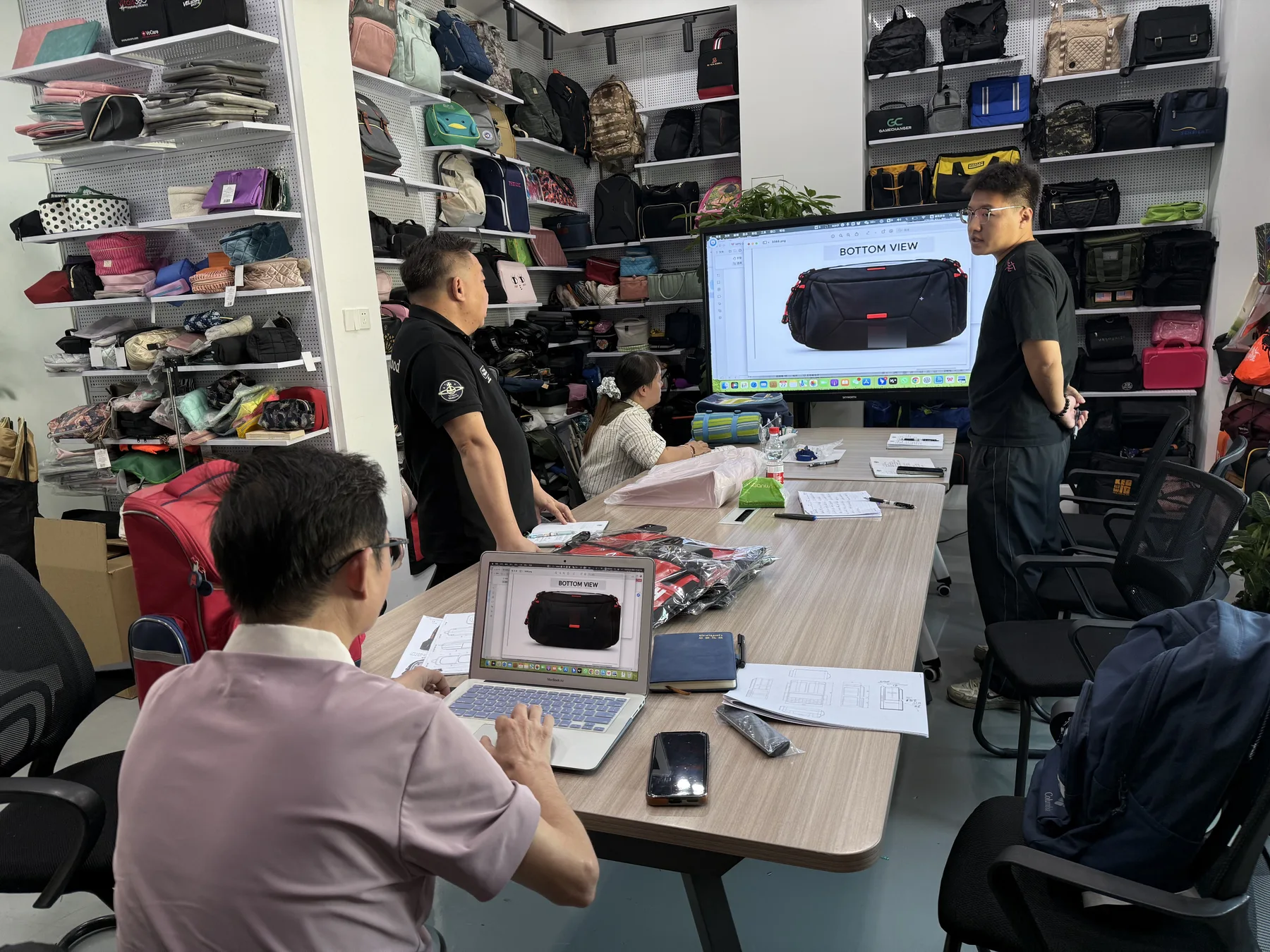
The buyer’s proposed bag raised connected design questions. Capacity, size and shape are not three independent numbers. Changing the depth of the main body can change how the pack sits against the back, how a side pocket works when the bag is full, and where the shoulder-strap attachments meet the shell. A drawing can show the intended look while leaving those practical relationships unresolved.
We also discussed webbing and buckles. A buckle is not adequately specified by naming its general type or pointing to a colored mark on a drawing. For sampling, the team needs to know which strap it closes or adjusts, how the wearer reaches it, the proposed webbing width and whether a particular reference component is mandatory. Where a buyer has a sample buckle or approved supplier reference, that is stronger evidence than a low-resolution image.
Attachment details deserve the same care. If an outdoor bag is meant to carry an item outside the main compartment, the item, location, retention method and access need to be identified. The factory should not assume that a visible loop is a tested climbing or load-bearing feature. Any performance requirement needs its own agreed test method and acceptance criteria.
The review also has a commercial side. A component change can affect sourcing, sample cost and the quotation basis. That does not mean the factory should make unilateral substitutions. It means the buyer should see proposed alternatives and approve the specification that the sample is meant to represent.
Start with the buyer’s use case, not the silhouette
The same outline can describe very different products. A pack that is carried for a short walk, a trekking pack worn with a heavier kit and a bag designed mainly to look like outdoor equipment may share visual cues while needing different access, adjustment and construction decisions. Before discussing fabric codes or stitching details, the buyer and factory should identify the intended use, target user and items to be carried. This does not mean inventing a universal “hiking backpack” specification. It means establishing the conditions against which this particular design will be reviewed.
Useful buyer inputs include a representative packing list, dimensions of any item that must fit, expected clothing layers, the way the bag will be put on and removed, and any features that must remain accessible while it is worn. If a hydration system, rain cover or external item is part of the concept, identify the actual reference item or interface. An undefined requirement such as “hydration compatible” can mean a sleeve, a tube exit, a hose keeper or a combination of them. Each interpretation changes the drawing and sample review.
The buyer may not yet know all of these answers. That is normal at an early stage. The important difference is between an open requirement and an assumed requirement. An open requirement can be assigned to a decision owner and revisited. An assumption that is not visible in the project record may become expensive only after a sample is made. When the team discusses alternative structures, each proposal should be described as an option for the buyer to evaluate, not as a feature already approved for the photographed design.
Priorities help when a drawing contains competing requests. A buyer can mark features as essential, desirable or exploratory. For example, if quick side-pocket access is essential but the outer silhouette is flexible, the factory can review pocket placement with that priority in mind. If the appearance is non-negotiable, the team should explain any access or construction compromise for the buyer to decide. A factory should not quietly trade away a required function to preserve a rendering, and a buyer should not discover that a decorative line was interpreted as a structural seam only after sampling.
The outcome of this first discussion should be a short design intent statement: who the backpack is for, what it must carry or do, which visual characteristics must be retained and which questions remain unresolved. It is a working brief, not a performance certificate. In the photographed meeting, the team was reviewing a buyer-supplied design. The images alone cannot establish the final intent statement or the buyer’s later choices.
Resolve size, capacity and shape as connected decisions
Dimensions are easy to copy into an email and easy to misunderstand. A height, width or depth is useful only when the measurement points and the condition of the bag are defined. Is height measured to the top of the soft body or to the highest part of a rolled or extended closure? Is depth taken with the pack empty, filled with a defined set of contents or flattened for packing? Does a side pocket contribute to a stated width? If two teams use different landmarks, both can report the same number while describing different bags.
Capacity needs the same discipline. A number printed on a preliminary drawing should be treated as the buyer’s stated target, not as independently verified volume. The team should ask whether the target refers only to the main compartment or includes specified pockets, how the intended contents will be arranged, and what measurement method or reference packing condition the buyer will accept. A backpack with many small compartments can have an appealing nominal figure while failing to hold one important item. Conversely, enlarging the main cavity may alter the pack’s back profile and the position of nearby pockets.
Shape affects how the bag is used and assembled. A tapered body, curved front panel or protruding lower pocket can influence access, pattern efficiency, seam placement and the way the bag appears when filled. A drawing may show the bag in an idealized full condition without showing how it collapses when nearly empty. The team can ask for side and bottom views, a physical reference or an agreed list of contents to make these trade-offs visible. If the buyer supplies a reference pack, record which aspects are being referenced: silhouette, internal arrangement, fit, materials or only a visual direction. A reference is not blanket permission to copy someone else’s protected design.
For the next drawing version, a dimension table should use named landmarks, units and a separate tolerance field. Leave a tolerance blank until it is agreed; do not fill it with a convenient standard number. Record the version of the drawing that the table belongs to. If a size change is proposed after a sample is made, note the pockets, straps and hardware affected by that change. This prevents a seemingly small adjustment to the shell from being treated as though it had no consequences elsewhere.
These checks are general manufacturing-review questions. The available photographs do not prove which dimensions or capacity method the buyer ultimately approved, so this article intentionally publishes none of those values as project results.
Review the carry system and components as one assembly
The straps, back panel, chest strap if included, hip belt if included, webbing and hardware work together. Moving an attachment point can change how a strap lies on a wearer. Selecting a different buckle can change the required webbing width or the position of an adjustment tail. Adding an external attachment can introduce a new reinforcement or interference question. A drawing review should therefore trace each proposed component through its connection to the rest of the bag, rather than approve a list of individual parts in isolation.
For each strap, the team can ask where it starts and ends, what it adjusts, whether it is intended to be operated while wearing the pack, and which reference user and clothing combination will be used to review it. For webbing, the buyer may care about width, color, hand feel, abrasion expectations or compatibility with a specified buckle. For hardware, the brief should identify function and reference before a particular component is locked in. A visually similar substitute may operate differently or require a different attachment method. Where the buyer wants a named component, ask for the exact specification and approval route rather than assuming any lookalike is acceptable.
External loops, clips and tool attachments deserve explicit limits. The buyer should identify the item to be secured and how it will be attached and removed. The team should discuss whether it could snag, obstruct access or interfere with adjustment. The presence of a loop on a concept drawing must not be marketed as a rated mountaineering or safety feature. If the planned product requires a load-bearing claim, the parties need a separate test requirement, method and evidence. This article makes no such claim about the customer drawing.
Construction proposals should be evaluated against the buyer’s use case and sample approval criteria. A material or buckle may look suitable on a screen but need physical review for stiffness, reach or assembly. On the other hand, a sample with tidy sewing does not prove a quantified strength rating. The project team should distinguish visual inspection, user observation, dimensional measurement and formal testing; they answer different questions. The separate carry-system sample guide explains how buyers can document fit and adjustment observations once a physical sample exists.
This integrated view is a reason to conduct a team review early. The buyer may think of a buckle as a color or style choice, while the sample maker sees its effect on webbing and assembly, and the sourcing team sees lead-time or availability implications. Bringing those perspectives into one recorded question gives the buyer a real decision instead of several disconnected replies.
Make the next revision traceable before asking for a quotation
An early-stage drawing can support a feasibility discussion. It cannot support an equally precise quotation for every possible construction. Before comparing prices, buyers should ask each factory what specification and assumptions its quote is based on. If one proposal uses a named buckle and another uses an unspecified alternative, the totals do not represent the same product. The same applies to fabric, padding, reinforcement, printing, packaging and the number of sample revisions included in a proposal.
A compact change record makes comparison possible. It need not be an elaborate software system: a numbered list of questions linked to the drawing version is enough to begin. Record the initial request, the alternative proposed, the buyer’s response and the impact on the next drawing or sample. Mark a question open until an authorized buyer representative accepts a direction. If a meeting generates two plausible options, retain both rather than blending them into a single ambiguous specification.
Consider a general example, not a claim about this photographed project: a drawing shows an external strap beside a bottle pocket. The team asks whether the strap is for compression, an accessory or purely appearance. If the buyer confirms compression, the next questions concern adjustment range and access to the pocket when the pack is full. If the buyer confirms accessory retention, the team needs the reference item and the proposed fastening method. The original drawing is the same; the sample brief and quote basis are not.
When a revision is sent back to the buyer, highlight what changed and what did not. A revised front view alone may hide a change to the side profile or interior. Keep the earlier file and approval message so the team can see whether a detail was intentionally changed, accidentally dropped or never decided. Name the reference sample and document version that a later bulk specification is based on. This is especially important when brand designers, procurement staff and factory teams participate at different times.
Price should be discussed as a consequence of a defined product, not as proof that the product has been fully defined. A buyer can request a provisional range for an early concept, but it should be labeled with assumptions and exclusions. A firm sample or production quotation should identify the version, component basis, quantity and packing requirements it covers. This article is about how to improve that basis; it does not state a price, lead time or minimum order for the customer shown in the photographs.
A useful clarification question is more specific than “Please confirm the design”
When a drawing is incomplete, sending it back with one vague request often creates another round of guesses. A productive question points to a feature, explains the decision it affects and asks for an answer the team can record.
- Instead of “What size is the backpack?”, ask which dimensions are fixed, where each dimension is measured and whether the target applies to an empty or packed bag.
- Instead of “Is the capacity correct?”, ask what items the buyer expects to carry and how the stated capacity should be interpreted and checked.
- Instead of “Which buckle?”, identify the strap position and request a reference, operating requirement or approval of proposed hardware.
- Instead of “Do you want this attachment?”, ask which item it must hold, where the user should reach it and whether a tested performance requirement applies.
- Instead of “Are the straps comfortable?”, ask who will wear the sample, over what clothing, with which representative contents and what observations will decide whether a revision is needed.
The buyer does not have to arrive with an engineering answer to every question. The value of a collaborative OEM review is that the team can turn an uncertain idea into clear alternatives. The buyer still decides which proposed direction meets the intended product and market.
How to keep a design discussion from losing its decisions
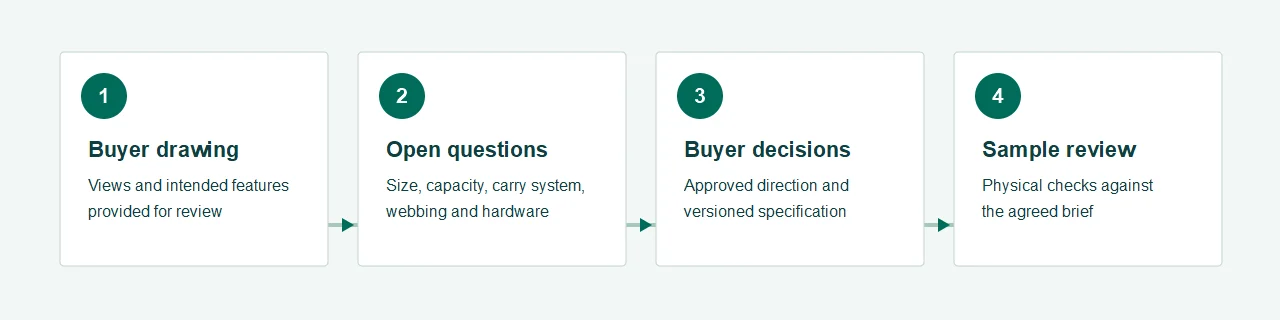
A meeting is useful only if its decisions survive the meeting. For each open item, a simple issue record can hold the drawing location, the current assumption, the buyer’s answer or requested proposal, the person responsible, the next action and the drawing or sample version affected. The point is not paperwork for its own sake; it is to prevent two people from approving different versions of the same feature.
A practical sequence is:
- Identify the source. Give the buyer’s drawing and any physical reference a version and date. Do not overwrite the original.
- Mark open questions. Tie each question to a location or numbered feature on that version.
- Offer constrained options. Where the buyer has not selected a component or construction, present alternatives with their trade-offs instead of silently choosing one.
- Record the buyer’s decision. Separate an idea under discussion from an approved instruction. Note who approved the change and which version it applies to.
- Define what the sample should resolve. Some questions can be answered on paper; others require a physical fit, access or assembly review. Put those questions on the sample checklist.
For a detailed method to brief and evaluate shoulder straps, back panels, hip belts and adjustment points, see our hiking backpack carry-system sample review guide. This case focuses on the earlier drawing-review conversation; it does not repeat that guide’s fit procedure.
Before sampling, agree on the minimum useful brief
The goal of a drawing review is not to pretend every unknown has disappeared. It is to identify which decisions must be made before making a meaningful sample and which decisions the sample is intended to test.
For a hiking backpack project, the buyer’s handover is stronger when it includes the intended use, reference users and contents, drawing version, priority dimensions, capacity interpretation, required compartments, carry-system goals, material and hardware references, logo and packaging needs, expected quantity, target market and any performance test that must be performed. A field may remain open, but it should be visibly open, with an owner and next step.
An initial sample should be evaluated against the agreed brief, not against a memory of what someone said during a call. If a sample reveals that a strap position, pocket opening or body proportion needs revision, the revised drawing and issue record should move together. A sample is not automatically approved because its appearance resembles the concept image.
Hongzhao’s custom hiking backpack manufacturer page covers the broader OEM/ODM options and what to prepare for a manufacturing discussion. This article addresses a narrower, earlier question: what happens when a buyer has a promising design but the production decisions behind it still need to be clarified?
What this real review demonstrates, and what it does not
The meeting demonstrates that a buyer’s preliminary backpack drawing can be reviewed collaboratively rather than being treated as an unquestioned production order. It shows the need to turn visible design features into explicit questions about size, structure, components and intended use.
It does not establish that this particular backpack reached an approved sample, that any named capacity or dimension was verified, or that its carrying, water-resistance or strength performance was tested. Those outcomes require project-specific records and approvals. Keeping the boundary clear is part of giving a buyer useful evidence rather than an inflated case-study claim.
If your team has an early-stage hiking backpack drawing, send the current version together with the use case, reference contents and the decisions you are most uncertain about. Hongzhao can review the open points with you and discuss what must be confirmed before sampling. Send your drawing for a project review.